
General manager for Hopkinsville Solid Waste Enterprise for the last two-plus years, Bryan Silver has myths to dispel about Christian County’s oft-discussed landfill.
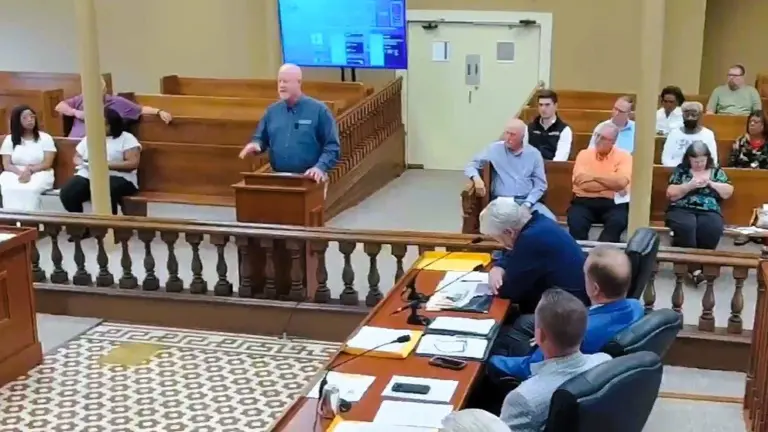
During Tuesday morning’s Christian County Fiscal Court meeting, he worked to clear the air about the consistent fires that occur on the property — many of which, he said, bring about “wild conspiracy theories” from the public regarding misuse, or some propagated notion that they are “running out of room” and need to “create space.”
In operation since 1968, Silver said their landfill is 15 acres and residual in nature — with lots of waste coming from industrial processes, greenery and construction debris.
From there, Silver confirmed several tons of refuse get shipped either to White Plains or Beaver Dam.
The most recent fires, he said, started through Liberty cut tires from Crittenden County, where recycled rubber is mulched for playgrounds and other high-traffic surfaces.
The leftover, he added, had to go somewhere, and HSWE was that place.
Tires, he said, have an increased fire risk because they can combust at 140 degrees or higher, and as such, they have quit taking the Liberty business.
Landfill fires, according to Silver, are “more common than most people think,” and because of HSWE’s proximity to neighbors, “more people notice.”
Silver confirmed that setting fires “on purpose to save space” would be extraordinarily expensive — ranging from $1,500 to $40,000 per event — and that such fires are “harmful to neighborhood relationships, and dangerous to the community, and hard for local authorities to put them out.”
One of the top causes of landfill fires, he said, are lithium batteries. Most people don’t have a good way to dispose them.
Mattresses, especially after being exposed to the elements, are terrific firestarters, Silver said, especially if glass reflects the sun’s rays back into heaping trash piles.
Silver also confirmed that chemical reactions, as well as “hot loads,” have created fires — as have unauthorized scavengers looking for copper and wire salvage.
They bring in backpacks and wagons late in the night, scab specific materials, and the burn plastic coatings off of cords in order to harvest better raw materials to sell.
Hopkinsville Fire Department, and other outside contractors, have also been key, but Silver said water isn’t the best extinguisher.
Instead, it takes dirt, dirt and more dirt to finish it, and fires can continue to burn for two-to-three months underground — with drones providing key infrared readings, as well as surface temperatures, for improved monitoring.
Load inspections and acre management, he closed, are the best fire prevention measures, but constant issues include consistent funding — either through grants or other supports — and increased landfill rates “are being explored,” as is the possibility of opening up a municipal solid waste landfill.