
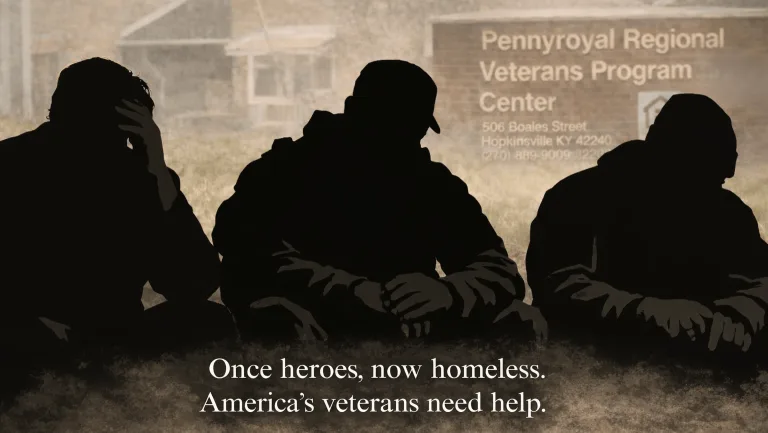
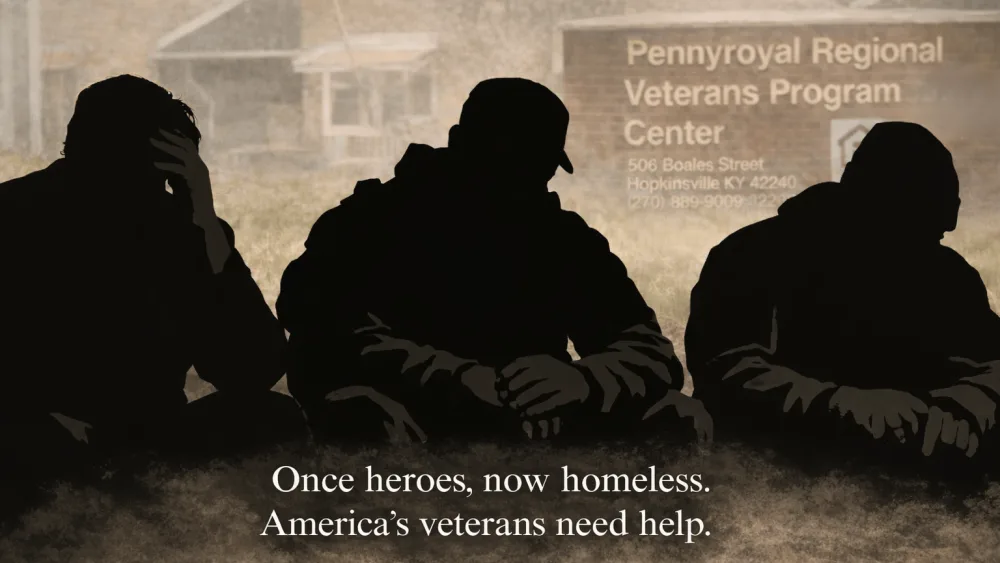
Photo created by photography and design from Edward Marlowe, ChatGPT and Canva.
Since 2010, and according to multiple national agencies, veteran homelessness has decreased more than 55% nationwide — as awareness, affordability and advocacy have all played their roles in creating more shelter and more supports for America’s discharged and displaced soldiers.
However, the problem persists — particularly in the News Edge listening area — and Hopkinsville’s Pennyroyal Veterans Center plays but one part in combating this issue.
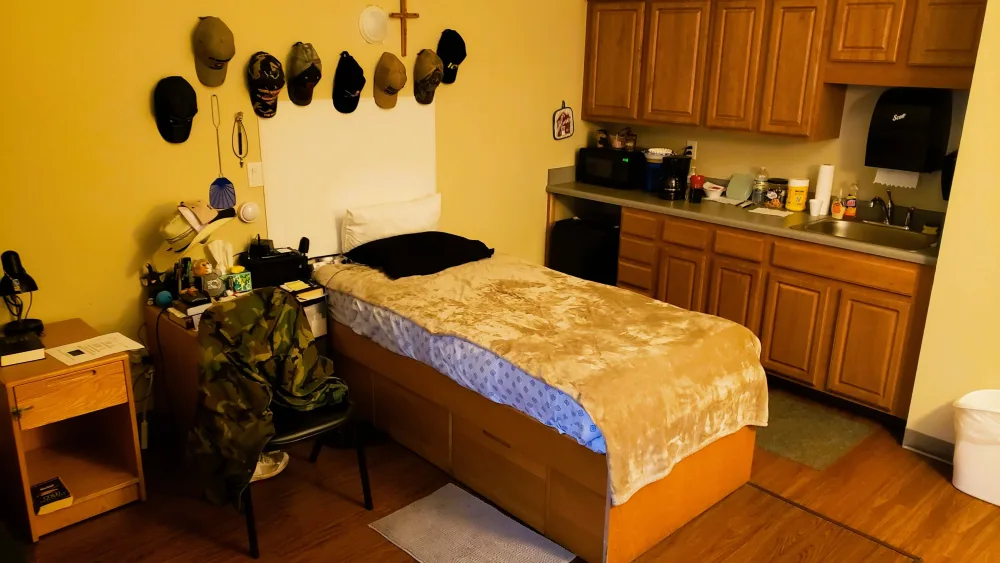
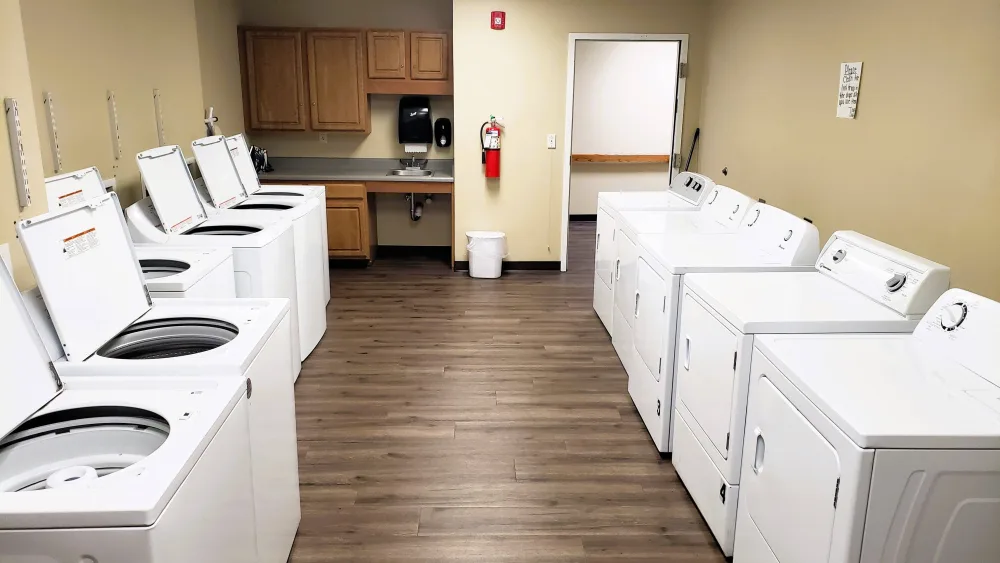
Open since March 2012 and long under the direction of Trigg County’s Jeff Broadbent and his experienced staff, its 50 beds remain at least “half full” at all times of the year — lost men with no other place to go.
In Kentucky, there are about 320 homeless veterans at any given point in time — more than 10% of them here.
And they, too, have a voice. Voices of loss. Voices of addiction. Voices of pain. Voices of struggle.
&&&&&
He won’t use his time in the military as an excuse for his habits, or his refusal to “do the right thing.” Nor does he like to be around other people when they are drinking.
In fact, it’s the main reason he won’t go to Knoxville, in order to cheer on his University of Tennessee Volunteers.
But in the quiet of the day, and with the roar of his thoughts, Alan always has two friends on which he can rely: alcohol and marijuana.
A native of Portland, Tennessee, he joined the military in August 1975 — in search of educational benefits, and hopes of brimming life elsewhere.
By his November 1982 discharge, he had been stationed at Fort Polk, Fort Bliss, Fort Lewis and Korea — and along the way had picked up drug addiction as a consuming hobby.
Perhaps ironically, Alan said Fort Bliss lived up to its name.
For one year, he attended Volunteer State Community College in Gallatin, before pivoting to being a car salesman in Nashville. Five years of that, however, was enough. In Tunica, Mississippi, he would spend the next seven years playing 10 hours of poker daily — using any winnings to support his choices.
There finally came a moment, however, where he knew he needed help. A way out of it all.
In 2012, the Pennyroyal Veterans Center became that place. And its director, Trigg County’s Jeff Broadbent, has been a key pillar of support for him.
Since then, Alan has lost count of his stays in Hopkinsville. “Too many,” he said, because he just “refuses to do the right thing.” And he admits he’s used the location as a crutch, because it’s so hard for him to transfer what he gets in their services, and apply it to real world situations.
But he needs routine. He needs comfort. He needs safety. He needs to be reminded to save money, to keep his blood, room and person clean.
Changes in his surroundings only complicate his addictions, and every time he leaves, he goes back to “his own little shell.”
His comfort zone.
His advice for other soldiers turned civilians: don’t be afraid to seek help, but take advantage of it and get serious about it when it arrives. He’s had difficulty adjusting to civilian life, because once he got out of the Army, he had the freedom to do whatever, and whenever, he wanted to do it.
This country, Alan said, has served him “more than he deserves.”
&&&&&
Even now, almost two years later, details remain hazy in his mind about how he arrived in Hopkinsville.
All Jamie knows is that prior to November 26, 2024, he boarded a Greyhound bus in Las Vegas — leaving his belongings, apartment and family behind — and had his sights set on starting a new life with a friend in North Carolina.
Somewhere around Atlanta, he had a medical episode — a “mental breakdown,” he calls it — and sought a cab from there to “either Nashville or Chattanooga,” before another breakdown forced an emergency room visit, and a transfer to the Murfreesboro VA.
Eventually, he was placed in the Pennyroyal Veterans Center — proud, but frustrated and confused, after his 14 years as a Marine and combat controls veteran.
A native of north Detroit and Class of 1996 graduate, he served from 1999 until 2013, when he was discharged from Whidbey Island, Washington.
He really loved his job, but he wasn’t going to get promoted to E6, and the military couldn’t write another contract for him. So, off he went into civilian life — where the day-to-day routine change “upset him.”
Working for the American Red Cross mostly suited him, he added, but he had trouble qualifying as a paramedic — because his skill set didn’t translate to the right throughput.
From 2018 until that late November evening, Jamie said he spent six years fighting with roommates — avoiding violence and simply bailing for the next best opportunity.
Hopkinsville, he said, has allowed him to regroup.
Currently, Jamie is canvassing some different jobs in the region, just so he can get back on his feet and eventually get back to Las Vegas — where friends and family are awaiting his return.
As a young man, though, the military felt like his only option.
He believes he would be a really good fit as a medical records assistant, or something in manufacturing and production — two jobs that provide that routine, that consistency most Americans want in a 9-to-5.
His family knows he is in Hopkinsville, and they call him about once a month — just to see if he’s making it.
&&&&&
A Memphis, Tennessee, native, Jerry dropped out of high school and joined the U.S. Army in 1971.
He still needed the family’s blessing, though, since he had two brothers in the service, but when one came home, away he went.
After basic training in Fort Campbell, and later Oklahoma, he spent two years as a repairman and radio communications installer — most of it stationed in Germany.
It’s here, Jerry said — twirling a cigarette between his fingers, and a cane at his side — that he started smoking marijuana and using crack-cocaine, two habits that chased him into his early 70’s.
He wanted to go to jump school and be part of the 101st Screaming Eagles, but he messed up his leg, and when he was discharged in 1973, these cycles “just kept going.”
Arriving in Hopkinsville and the Pennyroyal Veterans Center, he adds, was “a long-time coming.”
He got clean several times in between rehab visits, but obviously relapsed each time.
His first such journey into self-awareness and repair came in 1996, when he went to Murfreesboro for 100 days and remained there, before moving into a three-bedroom home with six similarly struggling men.
He claims he was the “last-man standing” after 18 months, a girl breaking his heart the final straw between sobriety and drowned sorrow.
Around 1998 until 2000, he thought he was doing well, when he had two jobs — one at Pillsbury — and was renting a mobile home.
Family in Memphis, though, wanted him to come home. So, he reluctantly packed his belongings and left stability behind, only for more trouble to be waiting.
Jerry would later meet his late wife in rehab near Nashville, and soon moved into pastorship of a church.
Her death in 2011, combined with his leadership not being renewed, led him to breaking his sobriety again in 2013.
He says she left him a fortune, one he burned through in six years. And from 2013 until 2018, Jerry said he floated around to places like Buffalo Valley in Clarksville, as well as Matthew 25 and Welcome Home Ministries in Nashville, at times enjoying brief glimpses into contentedness.
In 2021, however, Jerry fell off the map — walking away from his apartment and everything he knew, renting and running, facing two evictions along this path.
Now, after five decades of drug and alcohol abuse, he believes he has a wealth of advice for others seeking answers.
He had been at Pennyroyal before, and knew it was a place he could regroup and recover effectively.
In his mind, he needs longevity, and he does not need to be living in a major city, nor close to people he knows.