
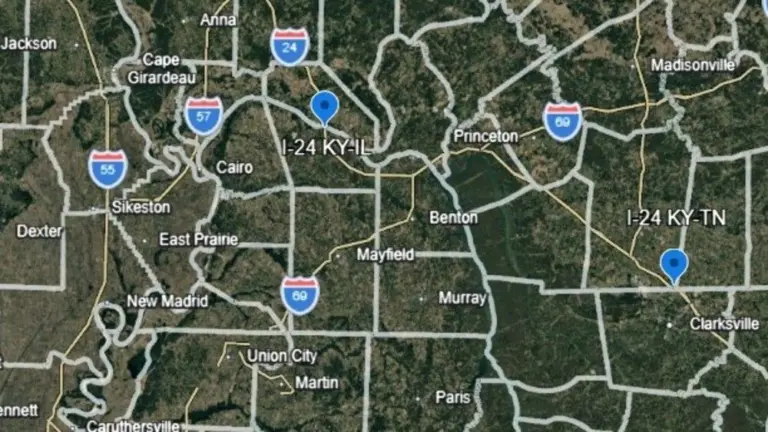
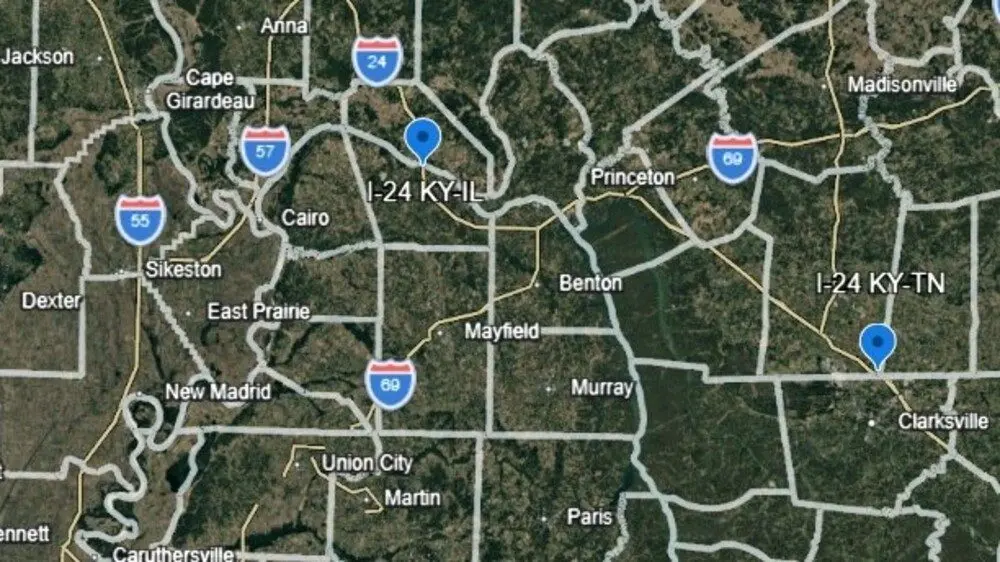
Roughly one year ago, officials with the Kentucky Transportation Cabinet initiated a scoping study, looking at the entire I-24 corridor from the Kentucky-Illinois state line to the Kentucky-Tennessee state-line — with the goal of collecting any and all data points for potential District I and II improvements and solutions.
Carrie Dillard, public information officer for District I, and other KYTC officials announced Monday the online release of the study in “story map” form — with an even lengthier report, one including stakeholder and elected official comments, expected late summer or early fall.
Several judge-executives — including McCracken County’s Craig Clymer, Trigg County’s Stan Humphries and Christian County’s Jerry Gilliam — have already offered public snapshots from their meeting in Hopkinsville last week.
However, more can be gleaned.
+ From Exit 3 near Paducah to Oak Grove is roughly 91 miles, and includes McCracken, Marshall, Livingston, Lyon, Trigg, Caldwell and Christian counties.
+ Current traffic levels for I-24 range from 22,600 to nearly 49,000 vehicles per day, depending on the stretch, and heavy truck and semi traffic accounts for 5,000-to-11,500 vehicles daily. By 2050, those volumes are expected to increase exponentially, between 43,400 and 80,200 along the route.
The existing four-lane interstate can currently handle traffic demands, but congestion is expected to become a major issue — particularly in McCracken and Christian counties — and if it hasn’t already.
+ Between 2022 and 2024, Kentucky’s portion of I-24 experienced more than 2,200 crashes, including 17 fatal and 355 with injury.
These numbers, Dillard confirmed, do point to problems that need to be solved sooner rather than later.
Suggested solutions include, but are not limited to:
+ The widening of I-24 from four to six lanes.
+ Replacing the major bridges over the Tennessee and Cumberland rivers.
+ Improving interchanges and ramps.
+ and expanding truck parking capacity along the thoroughfare.
As expected, bridge replacement — as well as all-out widening — would be the most expensive and time-consuming efforts. A Tennessee River Bridge estimate is close to $540 million, while a Cumberland River Bridge replacement is almost $390 million. Add in a third lane east- and westbound at nearly $35 million a mile, and Dillard said the price quickly increases.
The study also coordinates with neighboring states. Tennessee’s Department of Transportation currently plans I-24 widening work from mile point 0 to 11.1 in 2034, while Illinois transportation officials are studying widening needs at the Ohio River Bridge near Metropolis and Brookport.
The next step, Dillard noted, is to inform.
In the immediacy, several interchange improvements have been identified as priorities, including upgrades at Exits 4, 7, 27 and 86.
At Exit 7 near Paducah, four separate ramp and interchange improvements were proposed to reduce backups and improve traffic flow, with projected needs around 2035 and construction costs ranging from $1.6 million to $2.5 million.
Improvements at Exit 27 are estimated at $3.9 million and projected to be needed by 2030.
Work at Exit 86 would coincide with future interstate widening efforts, while the Exit 89 interchange project is already in the design phase.
Officials are also considering converting the former Lyon County rest area into a dedicated truck parking facility that would add 252 truck parking spaces at an estimated cost of $31 million.
The story map can be found here: https://storymaps.arcgis.com/stories/6fe3564db89b44afb22ac8b315d7ca5d