

ExxonMobil’s push into synthetic graphite production — and what it could mean for Hopkinsville’s role in the nation’s battery supply chain — took center stage Thursday as local leaders also stressed that infrastructure and utilities will be vital to sustaining economic growth in Christian County.
Speaking at the Christian County Chamber of Commerce’s Economic Development “Eye Opener” Breakfast, ExxonMobil Advanced Graphite Solutions Operations Manager Rob Bacon outlined the company’s acquisition of Superior Graphite assets and explained the synthetic graphite process used in lithium-ion batteries.
Bacon described how the material is engineered for use in battery anodes, positioning ExxonMobil to scale domestic production in a sector currently dominated by overseas suppliers.
The presentation put a spotlight on Hopkinsville’s growing role in the battery materials supply chain, even as broader industry conditions remain uncertain.
Synthetic graphite is a man-made form of carbon produced through high-temperature processing of carbon-based materials. In lithium-ion batteries, it is primarily used in the anode — the negative electrode that stores and releases lithium ions during charging and discharging.

Compared to natural graphite, synthetic graphite can be engineered for higher purity, more consistent structure and improved performance characteristics, which can enhance battery life, charging speed and thermal stability.
Because of these properties, synthetic graphite is considered a critical material in electric vehicle batteries, grid-scale energy storage systems and other advanced technologies driving global demand.
ExxonMobil’s investment speaks to a larger effort to build a domestic supply chain for this material, which has historically relied heavily on overseas production.
While ExxonMobil’s investment promotes opportunity, local leaders say the ability to support large-scale industry is becoming just as important as attracting it.
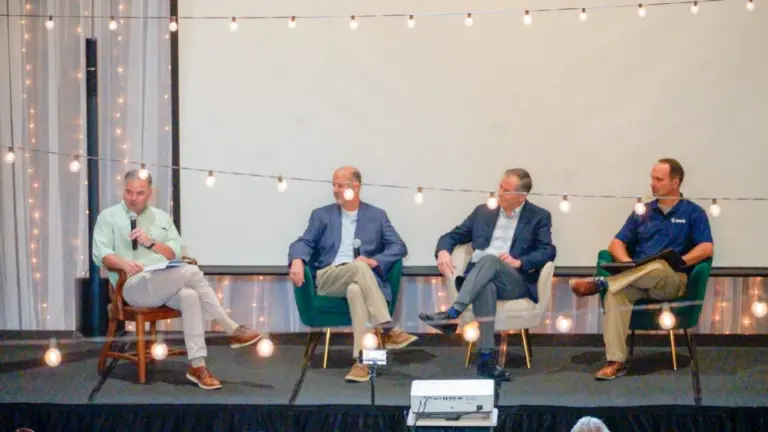
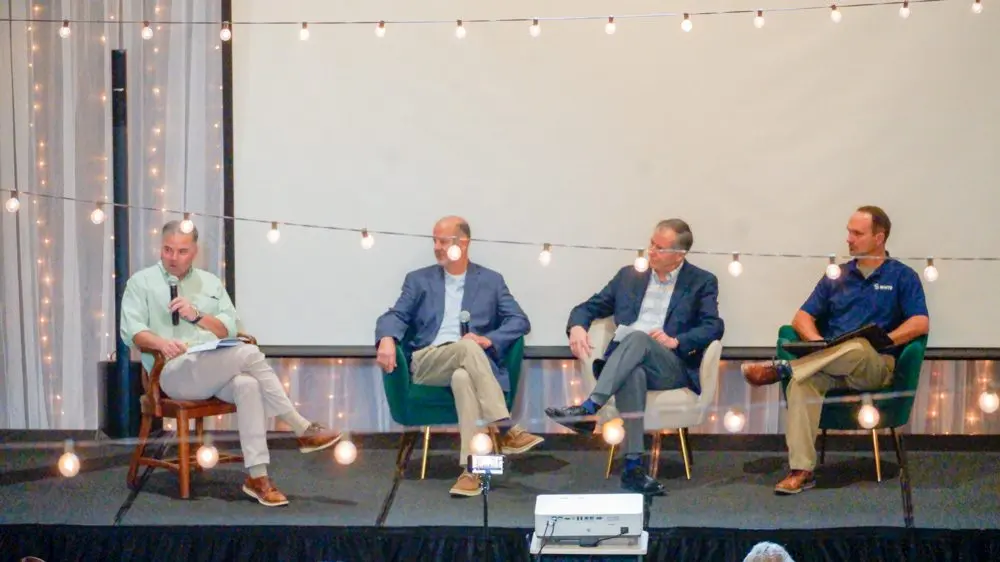
During a panel discussion following Bacon’s remarks, speakers emphasized the need for continued upgrades to electrical capacity, water and wastewater systems, and transportation infrastructure.
Panelists also pointed to housing and community development as part of the infrastructure equation, noting that workforce growth depends on available and affordable living options.
Christian County Chamber of Commerce Executive Vice President Chandler Ladd said the message of the day centered on shared responsibility for economic growth.
“We had three wonderful panelists who gave great insight to the fact that it’s not just one person’s responsibility to focus on economic impact in our community, it’s all of us.”
Ladd also pointed to ExxonMobil’s role as presenting sponsor and its investment in Hopkinsville.
“They gave a wonderful update about their purchase of Superior Graphite here in Hopkinsville and what they plan to do and how they’re going to be a part of our community.”
ExxonMobil’s acquisition of Superior Graphite assets aligns with Christian County’s long-term strategy to attract advanced manufacturing and energy-related industries.
Local officials have promoted assets such as available industrial land, including Commerce Park II, along with transportation access and regional workforce availability.
However, leaders also acknowledge that major industrial growth is beginning to strain existing infrastructure systems, creating urgency around long-term planning and investment.
That challenge is compounded by uncertainty tied to another major project in the community.
Ascend Elements, a lithium-ion battery recycling and materials company developing a facility in Commerce Park II, filed for Chapter 11 bankruptcy protection in April 2026.
The project, initially expected to bring significant investment and job creation, remains under construction but could see changes in ownership or direction as part of restructuring.
While operations could continue under new leadership, the situation introduces risk for a project once viewed as a cornerstone of a regional battery materials hub.
The contrast between ExxonMobil’s expansion and Ascend’s financial struggles shows broader volatility across the battery and electric vehicle supply chain.
Despite strong long-term demand for materials such as synthetic graphite, companies in the sector are navigating rising costs, shifting market conditions and evolving policy incentives.
For communities like Hopkinsville, that volatility increases the importance of infrastructure readiness — particularly in utilities — when competing for future projects.
At Thursday’s breakfast, Chamber officials and panelists stated that economic impact extends beyond large industrial investments.
Director of Events and Marketing Kaylee Upton said the takeaway was that every business plays a role in shaping local economic outcomes.
“We highlighted Exxon and what they’re coming to Hopkinsville to do,” she said. “And we also showed how everyone in the community is involved in economic impact. It’s not just big or small, it’s every size that there is.”
Upton added that participation across the business community is what drives sustained growth.
“No matter the size of your business, you’re making an impact in our community,” she said.
ExxonMobil’s investment provides a foothold for Christian County in the expanding battery materials sector, strengthening the region’s position within a growing advanced manufacturing corridor.
At the same time, infrastructure demands and uncertainty surrounding other projects point to the challenges that come with rapid industrial growth.
How the community addresses those challenges — particularly in utilities, housing and site readiness — will likely determine the pace and scale of future development.