

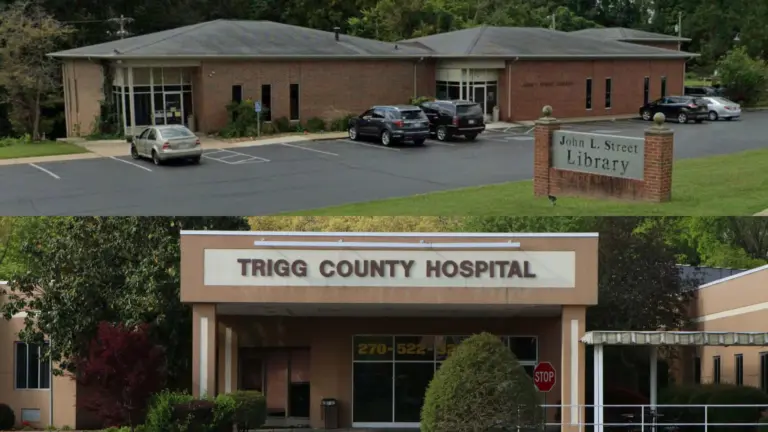
More clarity has come in the wake of Thursday night’s decision, in which the Trigg County Hospital and the John L. Street Library boards decided to trade property, in the name of mutual growth.
As things stand:
+ The library will outright receive the 16,000 square-foot Rose’s building, $100,000 cash and 10 months free rent on their current property, as renovation takes place at the new location.
+ In return, the hospital will receive the Mize’s property on Merchant Street, sized at more than four acres, and gain ownership of the current library, sized at about 9,000 square feet, and its property.
The “10 months free rent,” Metts re-confirmed, is so the library can continue to operate smoothly as it is now, while being tenants of what will be the hospital’s property when the documents are signed next week.
Metts is aware that in less than 12 hours of public reporting, some community members have expressed their dismay about the decision, and for a number of reasons.
However, she noted both parties collectively bargained efficiently and effectively, and the trade is expected to change the landscape of both organizations within the community.
The Rose’s building, Metts said, is made of metal and has more than four acres of land on which to expand. The current John L. Street Library is landlocked — surrounded by property already owned by the hospital — and is also made of brick, meaning any expansion of it would be “remarkably expensive,” and that those avenues have been previously explored.
Furthermore, Metts confirmed that early estimates of a brand-new library, one that would’ve been located between Hancock’s and Pennyrile Electric, came in around $6 million just before the pandemic. Building costs have since rocketed, and Metts said a renovation of the Rose’s building should cost between $1 and $1.5 million — barring contingencies. Hence, a relocation would save almost $5 million, if not more.
Moving the library one mile up the road from the school district does mean that foot traffic from the campus would be reduced. However, staff members confirmed that younger students are already bussed over by the Trigg County Schools Department of Transportation, and that less than a dozen students daily, on average, walk over after school. Furthermore, staff have had some difficulties slowing traffic in the area, despite the presence of a crosswalk, and there is a general belief that traffic congestion — commonly observed during early morning and afternoon pickups — will dissipate.
As for the Trigg County Hospital, and its apparent penchant for rural health clinics, multiple community members have echoed that procuring a local general practitioner has been, at times, “challenging,” as wait times have increased over the years.
In a November 2025 study completed by the University of Washington, Trigg County was categorized as a mild “healthcare desert,” based on several metrics. At present, there are less than 21 family physicians per 100,000 people, less than seven general internists per 100,000 people, less than 138 nurse practitioners per 100,000 people, and remains severely limited in general pediatrics availability.
Furthermore, Trigg County has less than 14 physician assistants per 100,000 people.
It’s also worth noting that of Trigg County’s 14,000-plus population, more than 11,000 are adults — with a significant number of seniors. While 18% of the county is 15 and younger, nearly 10% are specifically between the ages of 60 and 64 — just before Medicare and Medicaid usually triggers — and Trigg County’s median age is 45-to-46 years old, nearly seven years older than the state average of 39.
Thanks to its close proximity to Land Between the Lakes, Nashville, St. Louis, Louisville and Memphis, as well as Fort Campbell, Trigg County also continues to be one the nation’s leading retirement communities — a designation that will likely never fade, and only further affirms a need for a strong base of healthcare.
As for the library tax, less than 10% of the state’s counties are without it. Trigg County’s is 4.4 cents per $100 of assessed value — far below the legal ceiling of 20 cents per $100 of assessed value.
After failing to gain momentum in the late 1960s, traction warmed up on a local library tax in 1989, when the library board circled a petition asking for 3.5 cents per $100 of assessed value.
According to former Cadiz Record editor Janet James, former library board chair Mary White said the organization could “no longer stay in business” without an improved budget, which back then was $35,000 — and cited that “public donations, city and government contributions” weren’t enough.
Metts confirmed the board has only taken the compensating rate over the years, and that the tax “helps keeps the lights on, and water running.”
Since its 1954 arrival with a donated book mobile, the library has grown and developed at its Main Street location since the mid-1970s and celebrated but one expansion, completed in the summer of 1995.
And also, since 2020, two nearby libraries — Calloway County and Hopkinsville-Christian County — have undergone massive renovations, both of which have brought quality of life changes to their respective communities.
Officials with the Trigg County Hospital and John L. Street Library will sign on the trade next week.
HEALTH DATA: