

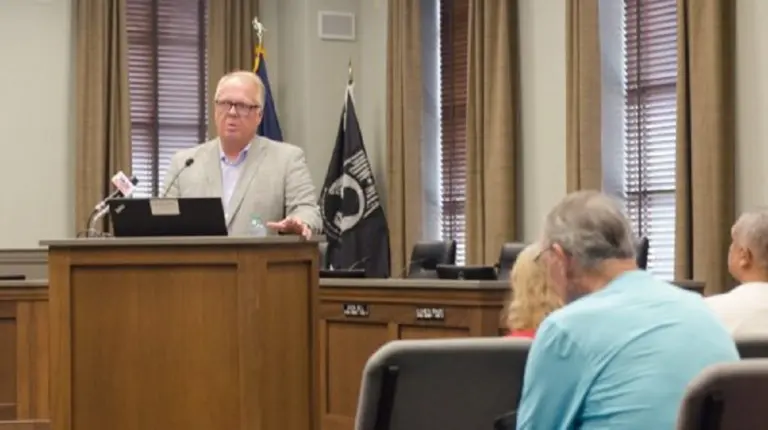
Community leaders, residents, and city officials all gathered to hear the results of a long-anticipated housing needs assessment conducted for the City of Hopkinsville.
Patrick Bowen, President of Bowen National Research, presented his company’s findings.
click to download audioThe numbers may be startling, but Bowen says they only confirm what many in the community already feel—especially low-wage workers.
click to download audioCity Administrator Troy Body says the city is looking for solutions—some creative, some legal, and all long overdue.
click to download audioBut the city faces its own limitations—over 1,000 vacant lots, $200,000 a year just to cut the grass, and layers of bureaucracy around property titles.
click to download audioFor Mayor James R. Knight Jr., the connection between housing and growth is clear. Without enough homes, new families—and new jobs—won’t come.
click to download audioKnight says fixing the city’s housing problem means investing in infrastructure, raising wages, and making Hopkinsville more livable—starting with the inner city.
click to download audioFrom vacant lots to rising rent, Hopkinsville’s housing crisis won’t be solved overnight. But city leaders say this time, they’ve got the data—and the will—to do something about it.
SUMMARY OF HOUSING NEEDS ASSESSMENT PRESENTATION – CITY OF HOPKINSVILLE
Patrick Bowen outlined the findings of a comprehensive housing needs assessment focused on Hopkinsville and its surrounding areas in Christian County. The study examined local demographics, housing stock, economic factors, and community input to assess the current challenges and future opportunities for growth.
Scope and Methodology
The assessment was centered on Hopkinsville as the primary study area, with the remainder of Christian County serving as a secondary study area, and comparative data from Kentucky statewide to provide context. The study analyzed:
- Demographic and economic trends
- Rental and for-sale housing availability
- Housing conditions and blight
- Input from community stakeholders and employers
- Projected housing needs across income levels
Key Findings
1. Stagnant Household Growth with Future Potential
Although Hopkinsville has seen a slight net loss of just over 100 households since 2010, projections indicate household growth is expected to resume. Key growth segments include adults aged 35–44 and seniors 65 and older, particularly those aging in place.
2. Increasing Higher-Income Households
By 2029, the most notable household growth is expected among those earning $60,000–$100,000+, both renters and homeowners. This includes in-migration from areas like Clarksville and Nashville as well as local income growth. However, Bowen cautioned against interpreting a decline in lower-income households as a diminished need for affordable housing.
3. Inbound Workforce, But They Live Elsewhere
Roughly 14,000 people commute into Hopkinsville daily, with two-thirds of the workforce living outside the city. Many of these workers, especially those aged 30–54 with incomes above $40,000, say they would consider living in Hopkinsville if appropriate and affordable housing were available.
“Housing is absolutely holding this community back,” Bowen said, pointing to limited housing inventory as a barrier to both population and economic growth.
4. Housing Affordability Mismatch
A critical finding was the gap between wages and available housing:
- Workers in common occupations (retail, food service, healthcare, etc.) often cannot afford fair market rent ($1,246 for a two-bedroom) or the median home price ($229,000).
- A high percentage of households are cost-burdened (paying over 30% of income on housing). More than 1,400 households are severely cost-burdened, paying over 50%.
5. Housing Stock Is Extremely Limited
- Rental occupancy in Hopkinsville is 97.6%, well above the healthy range of 94–96%. Affordable housing (tax credit or subsidized) is completely full with nearly 2,000 households on waitlists.
- Non-conventional rental housing (e.g., single-family homes) is also scarce, with a vacancy rate under 1%, far below the healthy rate of 4–6%.
- Homeownership inventory is similarly tight. Only 88 homes were available for sale in Hopkinsville at the time of the study, yielding a 1.3% availability rate, where 2–3% is ideal.
6. Housing Quality and Blight Are Concerns
- Over 300 households live in substandard housing (e.g., lacking plumbing or overcrowded).
- The residential blight rate is 2.8%, more than four times the national average. This includes 401 severely deteriorated homes, identified through a street-by-street visual survey.
7. Rising Home Prices
Though housing sales slowed slightly during the pandemic, home prices have sharply risen again in 2024. This makes homeownership more difficult for low- and moderate-income households but signals positive returns for developers.
8. Stakeholder and Employer Input
Community leaders and employers echoed the study’s findings. The most cited housing issues were:
- Limited availability
- Lack of affordability
- Substandard housing conditions
Employers reported housing issues were:
- Hindering their ability to attract new workers (36.8%)
- Making it harder to retain employees (21.1%)
- Preventing them from expanding their workforce (47.4%)
“You have a workforce that is really struggling to afford to live here,” Bowen said. “If you care about jobs and economic development, you have to care about housing.”
Recommendations
Bowen said that addressing the housing challenges will require local decision-making. The study provides:
- Housing gap estimates by tenure and income level
- Broad recommendations for expanding both affordable and market-rate housing
- Data tools for the city to target blight reduction and identify development opportunities
Final Takeaway
Hopkinsville has the potential for meaningful growth—both residential and economic—but faces a significant shortage of housing across all income levels. The study indicates urgent needs in:
- Affordable housing development
- Market-rate rental expansion
- Homeownership opportunities under $200,000
- Revitalization of aging and blighted housing stock
“This isn’t just a housing issue,” Bowen concluded. “It’s an economic development issue. It’s a workforce issue. And it’s one that’s going to require a community-wide response.”
1. Set Clear Community Housing Goals
- Use the data in the study to identify specific housing needs (e.g., rental vs. for-sale, quality, affordability).
- Prioritize areas such as senior housing, family housing, or housing preservation.
2. Build Capacity and Identify a Housing Champion
- Appoint a lead group or person (task force, coalition, consultant) to spearhead housing efforts.
- Ensure the responsibility doesn’t fall on the city alone—include the private sector and nonprofits.
- Involve employers in the housing discussion since they’re directly affected.
3. Explore Programs and Incentives
- Although the study didn’t analyze policies or land use, Bowen referenced a website link in the report offering resources and examples of housing programs that communities can adapt.
4. Continue Efforts to Address Housing Quality and Blight
- Acknowledge current progress in tackling residential blight and preserving existing housing.
- Study proactive models like Huntington, West Virginia for ideas on blight reduction.
5. Launch an Education and Outreach Campaign
- Educate the public, stakeholders, and advocates using the study’s data.
- Go beyond presentations—consider creative outreach strategies to increase awareness and engagement.
6. Build Development Partnerships
- Collaborate with for-profit and nonprofit developers, lenders, and other partners.
- Identify local and external groups that can be part of the housing solution.
7. Market the Community for Housing Development
- Promote Hopkinsville as a data-ready, development-friendly community.
- Share the housing study with developers and investors; Bowen plans to do this himself.
8. Attract Commuters to Live in Hopkinsville
- Many people work in Hopkinsville but live elsewhere due to limited housing options.
- Increase housing availability to encourage these commuters to move into the city.
To read more or get involved, visit the city’s website or attend upcoming neighborhood association meetings.